
---
title: "Pick Thickness, Taper & Flex: A Luthier's Guide" slug: "guitar-pick-thickness-taper-flex-guide-tone" description: "Go beyond simple gauge. Our luthier explains how thickness, taper, and flex interact to define the feel, response, and tone of your guitar pick." tags: - pick thickness - pick taper - pick flex - guitar tone - pick dynamics - lead guitar - rhythm guitar reading_time: 9 updated: 2025-09-16 series: "Custom Guitar Pick Series" pillar: "Geometry & Ergonomics" ---
_A quick, practical summary to get you started._
**TL;DR:** Pick thickness is more than just a number. **Thickness** controls the fundamental voice of the pick—thin for bright, snappy rhythm and thick for warm, powerful lead. **Taper** (how the pick thins towards the tip) fine-tunes the attack and feel, allowing a thick pick to feel more nimble. **Flex** is the result of material and geometry, determining how the pick “gives” against the string, affecting dynamics and perceived speed. Mastering the interplay of these three elements is the key to unlocking a new level of control over your tone.
---
The Three Dimensions of Feel
Ask a guitarist about their pick, and they’ll probably tell you its gauge. “I play a 1.0mm,” or “I use a .60mm.” Thickness is the most common metric we use to describe a pick, and for good reason—it’s the single most important factor in determining its fundamental tone and feel. But to stop there is to miss two-thirds of the story.
A pick is a three-dimensional object, and its behavior is governed by a trinity of interconnected properties: **Thickness**, **Taper**, and **Flex**. As a luthier, I don’t just see a flat piece of plastic; I see a complex spring, a carefully sculpted tool where every curve and contour has a purpose. Understanding how these three dimensions work together is the difference between choosing a pick and truly *designing* your sound.
This guide will break down each of these three pillars, explaining how they function independently and how they interact to create the playing experience you feel in your hand and hear through your amp.
Thickness: The Foundation of Tone
Overall thickness is the starting point. It establishes the pick’s mass and its basic relationship with the string. The general rule is simple and intuitive:
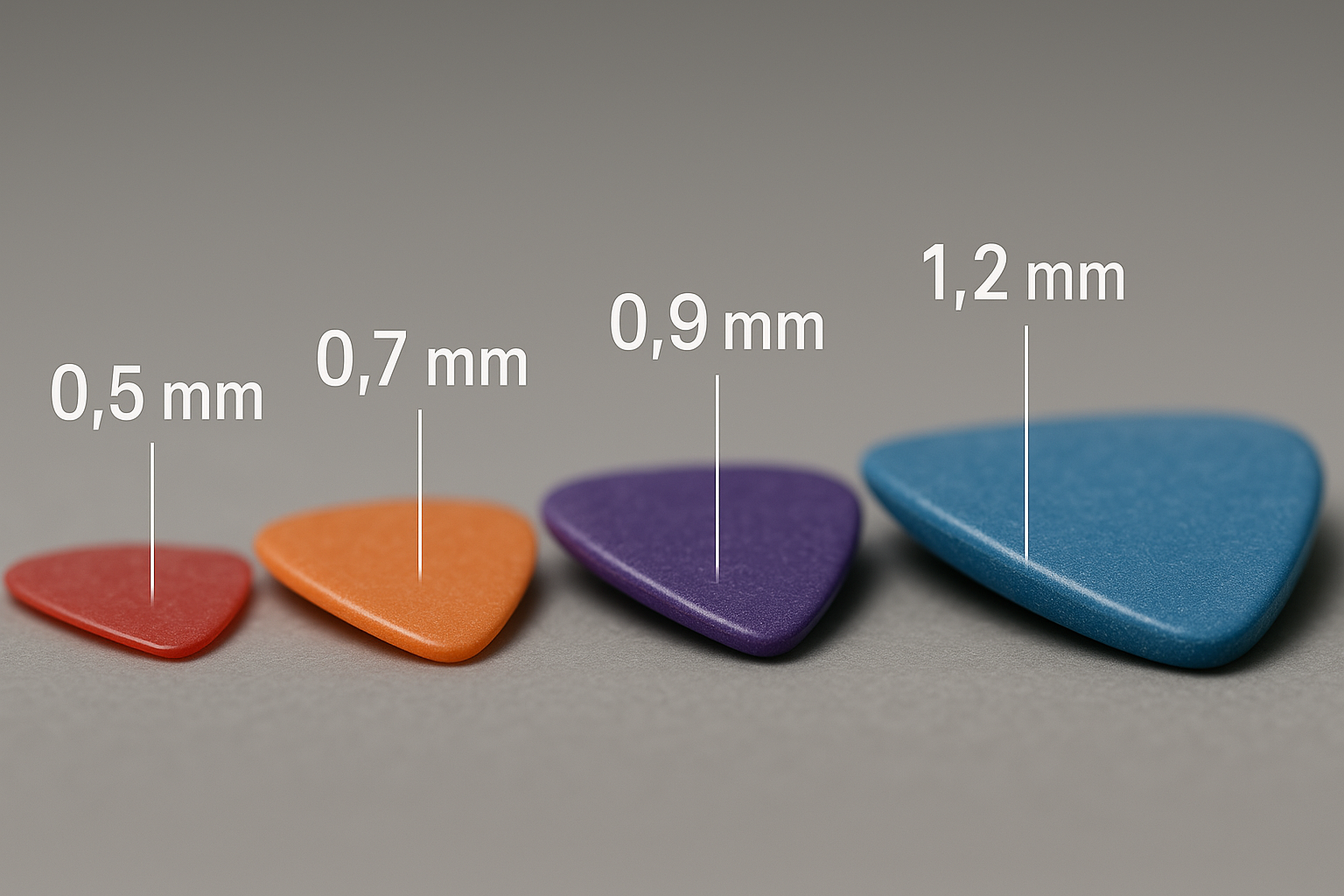
* **Thin Picks (under 0.75mm):** A thin pick has less mass and more give. When it strikes the string, it flexes, and much of the picking energy is absorbed by the pick itself. This results in a **brighter, snappier, and more percussive sound** with less low-end. The attack is sharp but quiet. This is why thin picks are fantastic for fast, rhythmic strumming on an acoustic guitar; they produce a clear, shimmery sound without overwhelming the instrument with bass.
* **Thick Picks (over 1.2mm):** A thick pick has more mass and is more rigid. When it strikes the string, it doesn’t flex; it moves the string. Nearly all of the picking energy is transferred directly to the string. This results in a **louder, warmer, and more powerful tone** with a much stronger fundamental note and more bass. The attack is full and authoritative. This is why lead players and flatpickers gravitate towards thick picks; they provide the power, volume, and warmth needed for single-note lines to sing.
* **Medium Picks (0.75mm - 1.2mm):** As you’d expect, these offer a compromise, blending the articulate snap of a thin pick with some of the warmth and power of a thick one. They are the versatile all-rounders.
Taper: The Art of the Transition
Taper is where the real artistry begins. Taper refers to the way a pick’s thickness changes as it moves from the body to the tip. A pick can have a **uniform thickness** (no taper), or it can have a **tapered profile**, where the body is thick and the tip is thinner.
This is a crucial concept that allows us to decouple feel from tone. Imagine a 2.0mm thick pick. It will have a very warm, powerful tone. But with a uniform thickness, it can also feel clumsy and slow. By introducing a taper, we can keep the thick body (for that warm tone and secure grip) but create a much thinner, more nimble tip.
* **The Effect of Taper:** A tapered design gives you the **best of both worlds**. The thick body provides the mass for a strong, warm fundamental, while the thinner tip provides the flexibility for a more articulate, responsive, and less chirpy attack. It makes a thick pick feel faster and more agile. This is a key feature of many high-end and boutique picks.
Flex: The “Give” and the Snap
Flex is not an independent variable; it is the **result** of the interplay between material, thickness, and taper. It describes how much the pick bends when it hits the string and, just as importantly, how quickly it snaps back to its original shape.
* **Material Flex:** Some materials are inherently more flexible than others. Nylon is very flexible. Ultem is very rigid. A 1.0mm nylon pick will have far more flex than a 1.0mm Ultem pick.
* **Geometric Flex:** This is where thickness and taper come in. A thin pick has a lot of geometric flex. A thick pick has very little. A tapered pick has a unique flex pattern, where the flex is concentrated at the tip.
The character of the flex is critical to the playing experience:
* **High Flex (like a thin nylon pick):** The pick bends easily and snaps back quickly. This creates a very dynamic, snappy response that is great for strumming. However, at high speeds on single notes, it can feel imprecise, as the timing of the note is dependent on the snap-back of the pick.
* **Low Flex (like a thick PEEK pick):** The pick has almost no give. The response is immediate and precise. Every nuance of your hand movement is transferred directly to the string. This is ideal for fast, technical playing where accuracy is paramount. However, it can also feel unforgiving and produce more pick noise if your technique is not clean.
* **Tapered Flex:** This offers a unique compromise. The body of the pick is rigid, providing a solid platform for your grip and a direct connection to the string. The tip, however, flexes slightly, absorbing some of the initial impact and providing a smoother, more forgiving release. It’s a controlled, sophisticated form of flex.
Designing Your Feel
By understanding this trinity, you can move beyond simply choosing a gauge and start truly designing your sound and feel.
* Want a **warm tone but a fast feel**? Choose a thick pick with a significant taper. * Want a **bright, rhythmic sound with lots of dynamics**? Choose a thin, flexible material like nylon. * Want **maximum precision and power**? Choose a thick, rigid material like PEEK with no taper.
Look at your current pick. Is it tapered? Where does it flex? How does that flex feel against the string? By asking these questions, you can begin to understand the subtle design choices that create the feel you love (or hate) and make more informed choices on your journey to the perfect pick.
---
Bench Notes
* **Material:** All materials are affected by these geometric properties. * **Thickness:** The primary driver of a pick's fundamental voice. * **Taper:** A key feature of many boutique picks, allowing for a combination of a thick body and a nimble tip. * **Flex:** The result of material choice and geometry, defining the pick's dynamic response. * **Grip Treatment:** N/A
Audio A/B Script
* **Riff/Lick:** A two-part test. Part 1: A simple, open-chord strumming pattern. Part 2: A fast, alternate-picked single-note scale run. * **Tempo:** 100 BPM (strumming), 140 BPM (scale). * **Bar Count:** 4 bars of each part for each pick. * **Pick Variants:** * A: A thin (0.60mm) Delrin® pick (high flex). * B: A thick (1.5mm) Delrin® pick with no taper (low flex). * C: A thick (1.5mm) Delrin® pick with a significant taper (tapered flex). * **Mic/DI Chain:** A versatile electric guitar with both humbuckers and single-coils, into a clean amp simulator. * **Gain Staging:** Peak-match all recordings to within 0.5 dB. * **What to Listen For:** In the strumming part, notice the bright, snappy sound of the thin pick (A). In the scale run, compare the powerful, warm-but-slightly-sluggish feel of the non-tapered thick pick (B) to the equally powerful but more articulate and agile feel of the tapered thick pick (C).
Visuals & Assets Brief
* **Image 1: The Trinity Diagram** * **Filename:** `pick-trinity-diagram.png` * **Alt Text:** A clean, triangular diagram with Thickness, Taper, and Flex at the corners, illustrating that they are the three key interacting elements of pick design. * **Purpose:** To create a strong, memorable graphic that communicates the core concept of the article. * **Image 2: Taper Profile Side-View** * **Filename:** `taper-profile-side-view.jpg` * **Alt Text:** A side-view photograph of two thick picks, one with a uniform thickness and one with a clear taper towards the tip. * **Purpose:** To visually explain the concept of taper in a clear and unambiguous way. * **Audio 1: Thickness, Taper & Flex Demo** * **Filename:** `thickness-taper-flex-demo.wav` * **Alt Text:** An audio player with three clips demonstrating the sound of a thin/flexible pick, a thick/rigid pick, and a thick/tapered pick. * **Purpose:** To provide a direct, audible comparison of how these three geometric properties affect tone and performance.
Internal Link Plan
* **Link out to:** * Post #10: Tips, Bevels & Edge Finishes (Anchor: "fine-tunes the attack") * Post #16: Metal, Prog & Shred (Anchor: "fast, technical playing") * Post #17: Funk/Neo-Soul & Pop Strumming (Anchor: "rhythmic strumming") * **Link in from (suggested):** * Post #1: The Custom Pick Playbook (Anchor: "Thickness, Taper & Flex") * Post #2: Match the Pick to the Guitar (Anchor: "the single most important factor")
SEO
* **Primary Keyword:** pick thickness * **Secondary Keywords:** * tapered guitar pick * pick flex * thick vs thin picks * **FAQ:** * **Does guitar pick thickness affect tone?** * Yes, dramatically. Thin picks (under 0.75mm) absorb much of the picking energy, resulting in a brighter, quieter, and more percussive tone ideal for strumming. Thick picks (over 1.2mm) transfer energy directly to the string, producing a louder, warmer, and more powerful tone with more bass, which is ideal for lead playing. * **What is a tapered guitar pick?** * A tapered pick is one that is thicker in the body (where you grip it) and becomes thinner towards the tip. This design gives you the warm, powerful tone of a thick pick while providing the fast, agile, and articulate feel of a thinner tip. * **What is pick flex?** * Pick flex describes how much a pick bends when it strikes the string. It is a product of the pick's material, its thickness, and its taper. A high-flex pick is snappy and dynamic (good for rhythm), while a low-flex pick is precise and powerful (good for lead). * **Clean URL Slug:** `pick-thickness-taper-flex-guide`
Schema
```json { "@context": "https://schema.org", "@type": "Article", "headline": "Pick Thickness, Taper & Flex: A Luthier's Guide", "author": { "@type": "Organization", "name": "Abbeytone" }, "dateModified": "2025-09-16", "about": ["pick thickness", "pick taper", "pick flex", "guitar tone"], "description": "Go beyond simple gauge. Our luthier explains how thickness, taper, and flex interact to define the feel, response, and tone of your guitar pick." } ```
Social Kit
* **Twitter/X:** Is your pick thick or thin? That's only 1/3 of the story. Learn how Thickness, Taper, and Flex combine to create your perfect feel and tone. #guitartone #luthier #geartalk * **LinkedIn:** The seemingly simple guitar pick is a complex spring governed by three interconnected properties: thickness, taper, and flex. This engineering breakdown explains how these geometric factors determine the plectrum's dynamic response, feel, and tonal characteristics, offering a deeper understanding for players and designers alike. #engineering #productdesign #musictech * **Instagram:** It's not just how thick it is. It's how it's built. #guitar #gear #tone
Newsletter Blurb
Is a 1.0mm pick always a 1.0mm pick? Not exactly. The simple gauge measurement on your favorite plectrum is only the beginning of the story. This week, we go three-dimensional, exploring the crucial interplay of Thickness, Taper, and Flex. Learn how these geometric properties define the way a pick feels, responds, and, most importantly, sounds.